Welcome to UPRO ACADEMY - Unlocking the Power of Education!











Full-length mock tests
🏆 JEE Main Pinnacle – Full-Length Mock Test Series
1 subject · 25 tests
₹819
Explore course →Free trial available →
Upro Academy is dedicated to helping students prepare for national and state-level entrance exams with structured courses, practice tests, and current affairs. Our focus is on clear concepts, repeated practice, and exam-ready confidence.
Learn MorePrepare for JEE Main 2027 with UPRO Academy's online mock tests and chapter-wise practice in Physics, Chemistry and Mathematics. Strengthen your conceptual understanding, improve problem-solving skills, enhance speed and accuracy, and track your preparation with detailed performance analysis.
Start Free Trial →Explore courses →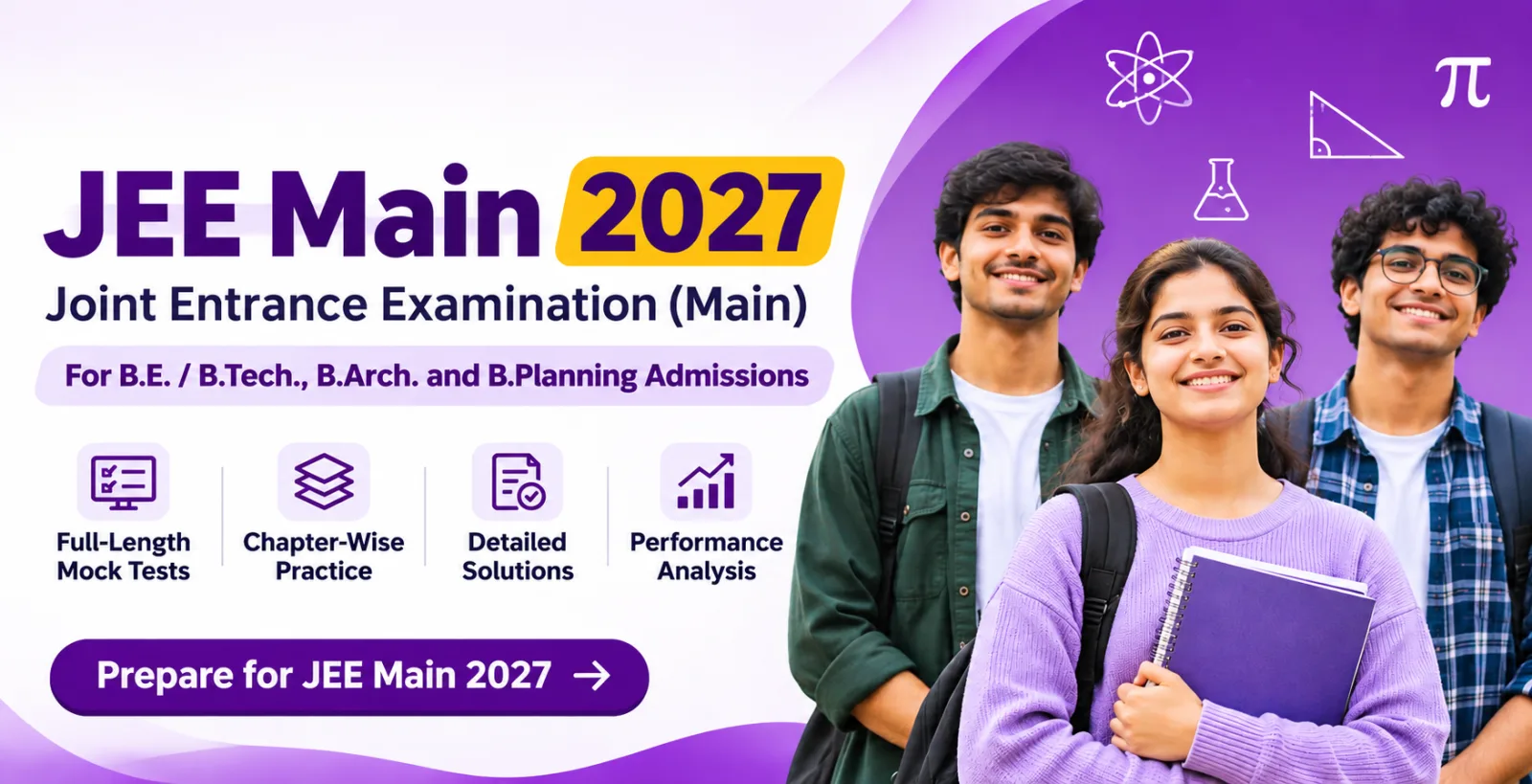
Understand the examination requirements before choosing your practice tests.
1 subject · 25 tests

1 subject · 20 tests

1 subject · 20 tests

1 subject · 14 tests
Explore examination documents and plan your preparation with relevant practice tests.
Download the official JEE Main 2027 syllabus published by the National Testing Agency (NTA). Refer to the prescribed Physics, Chemistry and Mathematics units and detailed subtopics for Paper 1 (B.E. / B.Tech.) preparation.
Explore eligibility, syllabus, examination pattern and admission information. Select a topic to read more.
The Joint Entrance Examination (JEE Main) is a national-level entrance examination conducted by the National Testing Agency (NTA) for admission to undergraduate engineering, architecture and planning programmes at participating institutions across India.
| Paper | Programme | Subjects |
|---|---|---|
| Paper 1 | B.E. / B.Tech. | Physics, Chemistry and Mathematics |
| Paper 2A | B.Arch. | Mathematics, Aptitude and Drawing |
| Paper 2B | B.Planning | Mathematics, Aptitude and Planning |
This preparation guide focuses on Paper 1 for B.E. and B.Tech. admissions.
The examination assesses candidates' conceptual understanding, numerical ability, analytical thinking and problem-solving skills in Physics, Chemistry and Mathematics.
Candidates should refer to the official JEE Main 2027 information bulletin for the applicable examination pattern, eligibility requirements, syllabus, examination dates and admission rules.
The National Testing Agency (NTA) has prescribed the following eligibility requirements for candidates appearing in JEE Main 2027.
There is no age limit for appearing in JEE Main 2027.
However, candidates must satisfy any age-related admission requirements prescribed by the institution in which they seek admission.
| Class 12 or Equivalent Examination Year | Eligibility |
|---|---|
| Passed in 2024 or earlier | Not Eligible |
| Passed in 2025 | Eligible |
| Passed in 2026 | Eligible |
| Appearing in 2027 | Eligible |
The qualifying examination passing year is the year in which the candidate was first declared to have passed Class 12 or an equivalent examination.
Appearing for an improvement examination or subsequently passing an additional subject does not change the original qualifying examination passing year.
Candidates must satisfy the applicable qualifying examination requirements. Recognised examinations include:
Candidates with qualifications from foreign or other unlisted boards may need an equivalence certificate from the Association of Indian Universities (AIU).
JEE Main Paper 1 assesses candidates in the following subjects:
Candidates seeking B.E. or B.Tech. admission must separately satisfy the qualifying examination subject combinations and educational requirements prescribed by the admitting institution and counselling authorities.
JEE Main 2027 is scheduled to be conducted in two sessions:
| Session | Examination Month |
|---|---|
| Session 1 | January 2027 |
| Session 2 | April 2027 |
Eligible candidates may appear in either one or both sessions.
For candidates appearing in both sessions, the better total NTA score is considered for preparation of the merit list and ranking.
The state code of eligibility is generally determined by the state in which the candidate passed the Class 12 or equivalent qualifying examination, rather than the candidate's native place or residential address.
Candidates appearing for improvement examinations in another state retain the state of eligibility associated with their original qualifying examination.
Special provisions apply to NIOS, BOSSE, overseas qualifications and OCI candidates as specified in the official information bulletin.
Eligibility to appear for JEE Main is different from eligibility for admission to NITs, IIITs and other participating institutions.
Candidates must satisfy the applicable Class 12 marks, subject combinations and other admission requirements prescribed by JoSAA, CSAB and the respective admitting institutions.
Candidates should verify the final 2027 admission regulations before participating in counselling.
Official JoSAA Website: https://josaa.nic.in/
Official CSAB Website: https://csab.nic.in/
According to the JEE Main 2027 Information Bulletin, Indian nationals seeking to appear for JEE Advanced must be among the top 2,50,000 successful candidates, including all categories, in JEE Main Paper 1.
Candidates must also satisfy the separate eligibility conditions prescribed by the JEE Advanced examination authorities.
Official JEE Advanced Website: https://jeeadv.ac.in/
The above eligibility information is based on the official JEE Main 2027 Information Bulletin. Candidates must refer to subsequent NTA notifications and the applicable institutional admission regulations for any changes or additional requirements.
Official Website: https://jeemain.nta.nic.in/
The National Testing Agency (NTA) has prescribed the examination pattern and marking scheme for JEE Main 2027 in its official information bulletin.
JEE Main Paper 1 is conducted for admission to B.E. and B.Tech. programmes at participating engineering institutions.
| Parameter | Official Details |
|---|---|
| Examination Mode | Computer-Based Test (CBT) |
| Paper | Paper 1 – B.E. / B.Tech. |
| Subjects | Physics, Chemistry and Mathematics |
| Question Types | Multiple Choice Questions and Numerical Value Questions |
| Total Questions | 75 |
| Maximum Marks | 300 |
| Standard Examination Duration | 180 minutes (3 hours) |
| Examination Duration for Eligible PwD/PwBD Candidates Entitled to Compensatory Time | 240 minutes (4 hours) |
| Number of Sessions | 2 |
| Subject | Section A (MCQs) | Section B (Numerical) | Total Questions | Maximum Marks |
|---|---|---|---|---|
| Physics | 20 | 5 | 25 | 100 |
| Chemistry | 20 | 5 | 25 | 100 |
| Mathematics | 20 | 5 | 25 | 100 |
| Total | 60 | 15 | 75 | 300 |
Physics, Chemistry and Mathematics carry equal weightage in JEE Main Paper 1.
| Response | Section A (MCQs) | Section B (Numerical) |
|---|---|---|
| Correct Answer | +4 marks | +4 marks |
| Incorrect Answer | -1 mark | -1 mark |
| Unanswered | 0 marks | 0 marks |
| Marked for Review Without an Answer | 0 marks | 0 marks |
Special marking provisions apply to questions with discrepancies, multiple correct answers or questions dropped after official answer key verification.
For numerical value questions found incorrect or dropped, four marks are awarded to all candidates who appeared in the relevant examination shift.
JEE Main 2027 is conducted in 13 languages:
The availability of regional examination languages depends on the examination centre location and the applicable NTA language selection rules.
| Session | Examination Month |
|---|---|
| Session 1 | January 2027 |
| Session 2 | April 2027 |
Candidates may appear in either one or both examination sessions.
For candidates appearing in both sessions, the better total NTA score is considered for merit ranking.
Raw examination marks are converted into NTA scores according to the prescribed normalization procedure.
NTA percentile scores are different from percentage marks.
The overall merit list is prepared by combining the applicable NTA scores across examination shifts and sessions.
When two or more candidates obtain the same total NTA score, the following criteria are applied in order:
| Priority | Tie-Breaking Criterion |
|---|---|
| 1 | Higher Mathematics NTA score |
| 2 | Higher Physics NTA score |
| 3 | Higher Chemistry NTA score |
| 4 | Lower ratio of incorrect to correct attempted answers across all subjects |
| 5 | Lower ratio of incorrect to correct attempted answers in Mathematics |
| 6 | Lower ratio of incorrect to correct attempted answers in Physics |
| 7 | Lower ratio of incorrect to correct attempted answers in Chemistry |
| 8 | Same rank if the tie remains unresolved |
The examination pattern, question distribution, marking scheme and ranking rules provided above are based on the official JEE Main 2027 Information Bulletin.
Candidates must refer to subsequent NTA notifications for any changes to the examination scheme or related instructions.
Official Website: https://jeemain.nta.nic.in/
The National Testing Agency (NTA) has published the official JEE Main 2027 syllabus for Physics, Chemistry and Mathematics.
The Paper 1 syllabus primarily covers Class 11 and Class 12 concepts. Students should develop strong conceptual understanding, numerical problem-solving skills and examination-oriented preparation.
The following subject-wise unit summary is provided to help students organise their JEE Main 2027 preparation according to the prescribed syllabus.
| Unit | Topic |
|---|---|
| 1 | Units and Measurements |
| 2 | Kinematics |
| 3 | Laws of Motion |
| 4 | Work, Energy and Power |
| 5 | Rotational Motion |
| 6 | Gravitation |
| 7 | Properties of Solids and Liquids |
| 8 | Thermodynamics |
| 9 | Kinetic Theory of Gases |
| 10 | Oscillations and Waves |
| 11 | Electrostatics |
| 12 | Current Electricity |
| 13 | Magnetic Effects of Current and Magnetism |
| 14 | Electromagnetic Induction and Alternating Currents |
| 15 | Electromagnetic Waves |
| 16 | Optics |
| 17 | Dual Nature of Matter and Radiation |
| 18 | Atoms and Nuclei |
| 19 | Electronic Devices |
| 20 | Experimental Skills |
| Unit | Topic |
|---|---|
| 1 | Some Basic Concepts in Chemistry |
| 2 | Atomic Structure |
| 3 | Chemical Bonding and Molecular Structure |
| 4 | Chemical Thermodynamics |
| 5 | Solutions |
| 6 | Equilibrium |
| 7 | Redox Reactions and Electrochemistry |
| 8 | Chemical Kinetics |
| Unit | Topic |
|---|---|
| 9 | Classification of Elements and Periodicity in Properties |
| 10 | P-Block Elements |
| 11 | D- and F-Block Elements |
| 12 | Coordination Compounds |
| Unit | Topic |
|---|---|
| 13 | Purification and Characterisation of Organic Compounds |
| 14 | Some Basic Principles of Organic Chemistry |
| 15 | Hydrocarbons |
| 16 | Organic Compounds Containing Halogens |
| 17 | Organic Compounds Containing Oxygen |
| 18 | Organic Compounds Containing Nitrogen |
| 19 | Biomolecules |
| 20 | Principles Related to Practical Chemistry |
| Unit | Topic |
|---|---|
| 1 | Sets, Relations and Functions |
| 2 | Complex Numbers and Quadratic Equations |
| 3 | Matrices and Determinants |
| 4 | Permutations and Combinations |
| 5 | Binomial Theorem and Its Simple Applications |
| 6 | Sequence and Series |
| 7 | Limit, Continuity and Differentiability |
| 8 | Integral Calculus |
| 9 | Differential Equations |
| 10 | Coordinate Geometry |
| 11 | Three-Dimensional Geometry |
| 12 | Vector Algebra |
| 13 | Statistics and Probability |
| 14 | Trigonometry |
The above unit-wise syllabus summary is based on the official JEE Main 2027 syllabus published by the National Testing Agency (NTA).
Candidates should download the complete official syllabus document for detailed subtopics, prescribed concepts, experimental skills and practical chemistry requirements.
The official NTA syllabus and subsequent amendments take precedence over this preparation guide.
Official Website: https://jeemain.nta.nic.in/
The National Testing Agency (NTA) has announced the JEE Main 2027 examination schedule for the January and April sessions in its official information bulletin.
| Event | Official Schedule |
|---|---|
| Online Registration | 24 October to 22 November 2026 |
| Last Date for Fee Payment | 22 November 2026 |
| Registration with Late Fee | 23 to 26 November 2026 |
| Application Correction Window | 27 to 29 November 2026 |
| Examination City Intimation Slip | 30 December 2026 |
| Admit Card Release | 13 January 2027 |
| Examination Dates | 20, 21, 22, 23, 24 and 28 January 2027 |
| Answer Key Release | As notified by NTA |
| Result Declaration | As notified by NTA |
| Event | Official Schedule |
|---|---|
| Online Registration | 5 January to 3 February 2027 |
| Last Date for Fee Payment | 3 February 2027 |
| Registration with Late Fee | 4 to 7 February 2027 |
| Application Correction Window | 8 to 10 February 2027 |
| Examination City Intimation Slip | 12 March 2027 |
| Admit Card Release | 25 March 2027 |
| Examination Dates | 2, 3, 4, 5, 6 and 7 April 2027 |
| Answer Key Release | As notified by NTA |
| Final Result and All India Rank | As notified by NTA |
An additional late application fee of Rs. 500 is applicable to candidates submitting their applications during the prescribed late registration period.
This late fee is uniform across all categories and is payable in addition to the applicable examination fee.
The registration, fee payment, late registration and application correction deadlines specified in the information bulletin are up to 11:50 PM on the respective closing dates.
| Examination Shift | Timing |
|---|---|
| First Shift | 9:00 AM to 12:00 Noon |
| Second Shift | 3:00 PM to 6:00 PM |
| Examination Duration | 3 hours |
All examination timings are in Indian Standard Time (IST).
Students should complete syllabus coverage, practise chapter-wise questions and attempt full-length mock tests before the January session.
After the first session, students can analyse their performance, strengthen weak chapters and improve their preparation for the April session.
The above schedule is based on the JEE Main 2027 Information Bulletin published by NTA. Candidates must follow subsequent official public notices for any changes to examination dates, registration deadlines or other examination-related arrangements.
Official Website: https://jeemain.nta.nic.in/
The JEE Main 2027 application process is conducted online through the official website of the National Testing Agency (NTA). Candidates must complete registration, fill in the application form, upload the required documents and pay the prescribed examination fee.
Candidates should keep the following documents and information ready before completing the application form:
Candidates must follow the official application portal instructions regarding photograph capture, document formats, file sizes and identity verification.
The following examination fees apply to candidates appearing for a single paper in each examination session.
| Category | Gender | Centres in India | Centres Outside India |
|---|---|---|---|
| General | Male | Rs. 1,000 | Rs. 5,000 |
| General | Female | Rs. 800 | Rs. 4,000 |
| GEN-EWS / OBC-NCL | Male | Rs. 900 | Rs. 4,500 |
| GEN-EWS / OBC-NCL | Female | Rs. 800 | Rs. 4,000 |
| SC / ST / PwD / PwBD | Male | Rs. 500 | Rs. 2,500 |
| SC / ST / PwD / PwBD | Female | Rs. 500 | Rs. 2,500 |
| Third Gender | Applicable Candidates | Rs. 500 | Rs. 2,500 |
The above examination fees are applicable per session. Candidates applying for both sessions must pay the applicable fees for each session.
Different examination fees apply to candidates selecting multiple examination papers.
Bank processing charges and applicable GST may be payable in addition to the examination fee.
Candidates submitting their applications during the prescribed late registration period must pay an additional late fee of Rs. 500.
This late fee is uniform across all categories and is payable in addition to the applicable examination fee.
| Event | Session 1 | Session 2 |
|---|---|---|
| Registration Begins | 24 October 2026 | 5 January 2027 |
| Regular Registration Ends | 22 November 2026 | 3 February 2027 |
| Late Registration | 23–26 November 2026 | 4–7 February 2027 |
| Correction Window | 27–29 November 2026 | 8–10 February 2027 |
Candidates should check subsequent NTA public notices for any revisions or extensions to the application schedule.
NTA provides an application correction facility during the prescribed correction period.
Candidates may modify only the fields permitted by NTA. Certain personal details, category information and other particulars may be subject to restrictions.
Candidates should carefully verify their application details before final submission instead of relying on the correction facility.
The application process is considered successful only after receipt of the prescribed examination fee.
If the confirmation page is not generated after payment, candidates should verify the transaction status with the concerned bank or payment gateway.
Candidates should contact the NTA helpdesk if the payment is confirmed successful but the confirmation page remains unavailable.
Successfully paid examination fees are generally non-refundable. Failed or duplicate transactions are handled according to the applicable verification and refund procedure.
| Contact | Details |
|---|---|
| Official Website | https://jeemain.nta.nic.in/ |
| Helpline Number 1 | 011-40759000 |
| Helpline Number 2 | 011-69227700 |
| jeemain@nta.ac.in |
The application procedure, examination fees and registration schedule are based on the official JEE Main 2027 Information Bulletin.
Candidates must follow subsequent NTA notifications and the instructions available on the official application portal.
UPRO Academy is an independent examination preparation platform and is not affiliated with the National Testing Agency.
Preparing for JEE Main 2027 requires a systematic study plan, strong conceptual understanding, consistent problem-solving practice and regular performance evaluation.
| Subject | Preparation Approach |
|---|---|
| Physics | Conceptual understanding, formula revision, numerical problems and experimental skills |
| Chemistry | NCERT revision, numerical calculations, chemical reactions and conceptual practice |
| Mathematics | Regular problem-solving, formula application, analytical thinking and calculation accuracy |
The following is a suggested six-hour self-study schedule. Students can adjust it according to their school, coaching and individual preparation requirements.
| Activity | Daily Duration |
|---|---|
| Physics | 90 minutes |
| Chemistry | 90 minutes |
| Mathematics | 120 minutes |
| Revision and Formula Practice | 30 minutes |
| Practice Test and Error Analysis | 30 minutes |
| Total | 6 hours |
| Preparation Phase | Primary Objective |
|---|---|
| Foundation | Understand concepts and strengthen fundamentals |
| Chapter Practice | Complete chapter-wise MCQs and numerical problems |
| Syllabus Completion | Cover remaining topics and revise weak chapters |
| Mock Test Practice | Attempt full-length examination-oriented tests |
| Final Revision | Revise formulas, important concepts and previous mistakes |
| Preparation Stage | Recommended Frequency |
|---|---|
| Foundation Stage | 3–5 chapter-wise tests per week |
| Intermediate Stage | 1 full-length mock test per week |
| Advanced Stage | 2–3 full-length mock tests per week |
| Final Preparation | 3–4 full-length mock tests per week, with adequate analysis and rest |
The following is a suggested time allocation for a three-hour mock examination.
| Subject / Activity | Suggested Time |
|---|---|
| Chemistry | 40 minutes |
| Physics | 55 minutes |
| Mathematics | 70 minutes |
| Final Review | 15 minutes |
| Total | 180 minutes |
Students should adjust their subject order and time allocation according to their individual strengths and mock test performance.
After completing each mock test, evaluate:
UPRO Academy helps JEE Main aspirants build examination readiness through structured online practice.
Consistent practice, effective revision and regular mock test analysis can help students improve their examination performance.
Start your JEE Main 2027 preparation with UPRO Academy and develop the confidence, accuracy and problem-solving skills required for the examination.
JEE Main is an important entrance examination for students seeking admission to undergraduate engineering programmes at participating institutions across India.
| Institution Type | Admission Basis |
|---|---|
| National Institutes of Technology (NITs) | JEE Main Rank |
| Indian Institutes of Information Technology (IIITs) | JEE Main Rank |
| Government Funded Technical Institutions (GFTIs) | JEE Main Rank |
| Participating State Engineering Colleges | JEE Main Rank and applicable state admission rules |
| Participating Private Universities | JEE Main Score and institutional admission rules |
| Indian Institutes of Technology (IITs) | JEE Advanced Rank and applicable eligibility requirements |
The above institutions are illustrative examples and are not presented in ranking order.
| Engineering Branch | Major Areas of Study |
|---|---|
| Computer Science and Engineering | Programming, algorithms and computer systems |
| Artificial Intelligence and Data Science | Machine learning, data analytics and intelligent systems |
| Information Technology | Software development and information systems |
| Electronics and Communication Engineering | Electronics, communication and embedded systems |
| Electrical Engineering | Electrical systems, power and control |
| Mechanical Engineering | Machines, manufacturing and thermal systems |
| Civil Engineering | Construction, infrastructure and structural engineering |
| Chemical Engineering | Chemical processes and industrial production |
| Aerospace Engineering | Aircraft, spacecraft and propulsion systems |
| Biotechnology | Biological sciences and engineering applications |
Branch availability varies according to the institution.
The Joint Seat Allocation Authority (JoSAA) coordinates seat allocation for participating IITs, NITs, IIITs and other Government Funded Technical Institutions.
The general admission process includes:
| Step | Admission Process |
|---|---|
| 1 | Appear for JEE Main or JEE Advanced, as applicable |
| 2 | Obtain the applicable examination rank |
| 3 | Complete online JoSAA registration |
| 4 | Fill in preferred institutions and engineering branches |
| 5 | Review and lock choices according to the counselling rules |
| 6 | Participate in seat allocation rounds |
| 7 | Accept the allotted seat and pay the applicable fee |
| 8 | Upload documents and complete verification |
| 9 | Complete reporting and institutional admission formalities |
The Central Seat Allocation Board (CSAB) may conduct special counselling rounds for vacant seats in participating NITs, IIITs and other GFTIs after the regular JoSAA counselling process.
Candidates must follow the applicable CSAB registration, eligibility, choice-filling and seat allocation rules.
Official Website: https://csab.nic.in/
Admission to engineering institutions depends on several factors:
Students should consider the following factors before selecting an institution:
Candidates should review official institutional information and previous-year opening and closing ranks before submitting their counselling preferences.
JEE Main serves as a qualifying examination for eligible candidates seeking to appear for JEE Advanced.
Admission to undergraduate programmes at IITs requires a valid JEE Advanced rank and fulfilment of the applicable eligibility and counselling requirements.
Official JEE Advanced Website: https://jeeadv.ac.in/
| Authority | Official Website |
|---|---|
| JEE Main – NTA | https://jeemain.nta.nic.in/ |
| JoSAA Counselling | https://josaa.nic.in/ |
| CSAB Counselling | https://csab.nic.in/ |
| JEE Advanced | https://jeeadv.ac.in/ |
| National Institutional Ranking Framework | https://www.nirfindia.org/ |
The above information describes the general engineering admission process based on established counselling arrangements. The participating institutions, seat matrix, reservation rules, eligibility requirements, counselling schedule and admission procedures for 2027 must be confirmed through the respective official authorities.
Qualifying JEE Main does not automatically guarantee admission to any particular institution or engineering branch.
UPRO Academy provides a structured online test preparation platform designed to help JEE Main aspirants strengthen their concepts, improve problem-solving skills and develop examination confidence.
UPRO Academy offers online test series designed to support students at different stages of their JEE Main preparation.
Students can explore available full-length mock tests and chapter-wise test packages according to their preparation requirements and budget.
Explore available free trial tests before purchasing a test series. Experience the online examination interface, question practice and available performance review features.
| Preparation Stage | UPRO Academy Practice Approach |
|---|---|
| Concept Building | Chapter-wise practice |
| Strengthening Fundamentals | Subject-focused question practice |
| Syllabus Revision | Systematic chapter revision |
| Examination Readiness | Full-length mock tests |
| Performance Improvement | Answer review and error analysis |
| Final Preparation | Timed practice and targeted revision |
Build stronger concepts, improve your accuracy and develop examination confidence through consistent practice with UPRO Academy.
Every mock test is an opportunity to identify mistakes, strengthen your preparation and work towards your engineering career goals.
Work through chapter-wise tests and full-length mocks.
Practise under timed conditions to improve your pace.
Review your performance and focus on weaker topics.
JEE Main 2027 is a national-level entrance examination conducted by the National Testing Agency (NTA) for admission to undergraduate engineering, architecture and planning programmes at participating institutions. It also serves as a qualifying examination for eligible candidates seeking to appear for JEE Advanced.
JEE Main 2027 is scheduled to be conducted in two sessions. Session 1 is scheduled for 20, 21, 22, 23, 24 and 28 January 2027. Session 2 is scheduled from 2 to 7 April 2027. Candidates should check the official NTA website for subsequent schedule revisions and their individual examination date and shift.
Candidates who passed Class 12 or an equivalent qualifying examination in 2025 or 2026, or are appearing in 2027, are eligible to appear for JEE Main 2027. There is no age limit for appearing in the examination. Candidates must separately satisfy the admission eligibility requirements of their preferred institutions.
JEE Main 2027 Paper 1 is a computer-based examination consisting of 75 questions carrying a maximum of 300 marks. Physics, Chemistry and Mathematics each contain 20 multiple-choice questions and five numerical value questions. The standard examination duration is 180 minutes.
Yes. Both multiple-choice questions and numerical value questions carry four marks for a correct answer and a penalty of one mark for an incorrect answer. Unanswered questions receive zero marks. Numerical answers must be rounded to the nearest integer.
The official JEE Main 2027 Paper 1 syllabus covers Physics, Chemistry and Mathematics, primarily based on Class 11 and Class 12 concepts. Students can download the complete prescribed syllabus from the official NTA website or access it through the syllabus resources available on this UPRO Academy page.
NCERT textbooks provide an important foundation for JEE Main preparation, particularly in Chemistry. However, students should supplement NCERT study with numerical problem-solving, previous-year questions, chapter-wise practice and full-length mock tests to develop the analytical skills and examination readiness required for JEE Main.
Students can explore JEE Main 2027 online mock tests on UPRO Academy. The platform offers examination-oriented practice in Physics, Chemistry and Mathematics, detailed solutions and performance analysis to help students improve their preparation.
UPRO Academy provides free trial tests where available, allowing students to experience the online examination platform before purchasing a test series. Visit the JEE Main test series page to explore available free trial tests and preparation packages.
Yes. UPRO Academy offers chapter-wise practice tests in Physics, Chemistry and Mathematics to help students strengthen individual concepts, identify weak topics and improve problem-solving skills before attempting full-length JEE Main mock tests.
The ideal number of mock tests depends on syllabus completion and individual preparation levels. Students can begin with one full-length mock test per week and gradually increase to two or three tests per week as the examination approaches. Reviewing mistakes and improving weak areas is more important than simply attempting a large number of tests.
Yes. Eligible candidates can appear in either one or both sessions of JEE Main 2027. For candidates appearing in both sessions, the better total NTA score is considered for merit ranking. Appearing in both sessions is not mandatory.
The cost of JEE Main test series depends on the selected preparation package. UPRO Academy offers full-length mock test and chapter-wise practice packages. Students can view the latest prices, available tests, package details and free trial availability directly on the JEE Main test series page.
JEE Main ranks are used for admission to participating NITs, IIITs, Government Funded Technical Institutions and various other engineering colleges. Admission depends on examination rank, category, seat availability, educational eligibility and applicable counselling rules. Admission to IITs requires qualification through JEE Advanced and fulfilment of the applicable admission requirements.
The official JEE Main website is https://jeemain.nta.nic.in/. Candidates should visit this website for examination notifications, online registration, information bulletins, syllabus, admit cards, answer keys, results and other official announcements.
Choose your test series and take the next step in your exam preparation.
Explore courses